




Agentic AI shopping is hot but is your technology stack ready for it?
Agentic AI Shopping is reshaping retail, but success depends on a unified data, integration and orchestration foundation that enables AI to scale.




Agentic AI Shopping has quickly become the defining conversation in retail technology. From Google to Shopify, vendors across the commerce ecosystem are launching capabilities designed to power this new era of AI-driven commerce. AI assistants that curate assortments, autonomous agents that optimise baskets and systems that dynamically adjust pricing and fulfilment are moving from concept to pilot, particularly among leading US retailers.
The ambition is clear: AI that operates inside the customer journey, interprets intent, applies commercial logic and executes decisions in real time.
The opportunity is significant. Executed well, Agentic AI Shopping can increase conversion, improve margin, reduce stock risk and enhance customer experience, while increasingly becoming a new surface for customer acquisition as AI-led discovery grows.
However, Agentic AI is not a feature that can simply be layered onto an existing stack. It is an operational capability that depends entirely on the strength and real-time integrity of the foundation beneath it.
Retailers do not struggle because algorithms are weak. They struggle because the architectural layers required to support AI are fragmented.
The five layers that must work in unison
To scale Agentic AI Shopping, five layers must be unified and synchronised:

- Agentic AI is the decision engine that interprets customer intent and acts autonomously within commercial guardrails. It coordinates cross-system responses in real time, but only works effectively when the layers beneath it are aligned.
- Analytics provides the predictive and optimisation intelligence that informs those decisions, from demand forecasting and propensity scoring to margin and promotion optimisation. Insights must feed execution, not sit isolated in dashboards.
- Orchestration ensures decisions are executed consistently across systems by coordinating triggers, workflows and business rules. Without orchestration, AI produces recommendations; with it, AI becomes operational.
- Data Management guarantees that customer, product, sales and inventory data are accurate, complete, structured and governed at an event level. Agentic AI fails when the data beneath it is inconsistent or untrusted.
- Integration forms the base layer, connecting e-commerce, POS, ERP, CRM and supply chain systems through API-first, event-driven and bi-directional flows. Without real-time integration, AI decisions rely on delayed signals.
These layers cannot operate as isolated initiatives. They must function as a unified, continuously synchronised foundation. When Integration, Data Management, Orchestration and Analytics operate in silos, Agentic AI becomes fragile and inconsistent. When they work in unison, AI becomes scalable, repeatable and commercially safe.
Retailers must think beyond pilots. The goal is not to launch a compelling demo, but to ensure that what is deployed to customers can scale across categories, regions and channels without introducing operational risk.
This is only the first wave
Agentic AI Shopping may dominate today’s headlines, but it represents only the first wave of AI-driven commerce. Industry forecasts suggest that by 2030 AI agents could account for 15–25% of US e-commerce sales, potentially driving $300 to $500 billion in annual retail transactions (Bain).
Autonomous replenishment agents are already emerging, capable of monitoring demand and triggering stock actions without human intervention. AI-driven merchandising engines are reshaping storefronts dynamically. Conversational commerce environments are merging discovery, advertising and checkout into unified AI-led experiences.
Advertising and marketing activation will increasingly move into these AI-driven environments, requiring retailers to plan and optimise campaigns inside agent-led journeys. New monetisation models will follow as brands seek visibility within AI-curated experiences. Retailers unable to integrate these capabilities quickly will find themselves reacting rather than leading.
This is why the foundation matters. Competitive advantage will not come from adopting a single AI capability first. It will come from having the architectural flexibility to integrate and operationalise each new wave as it emerges.
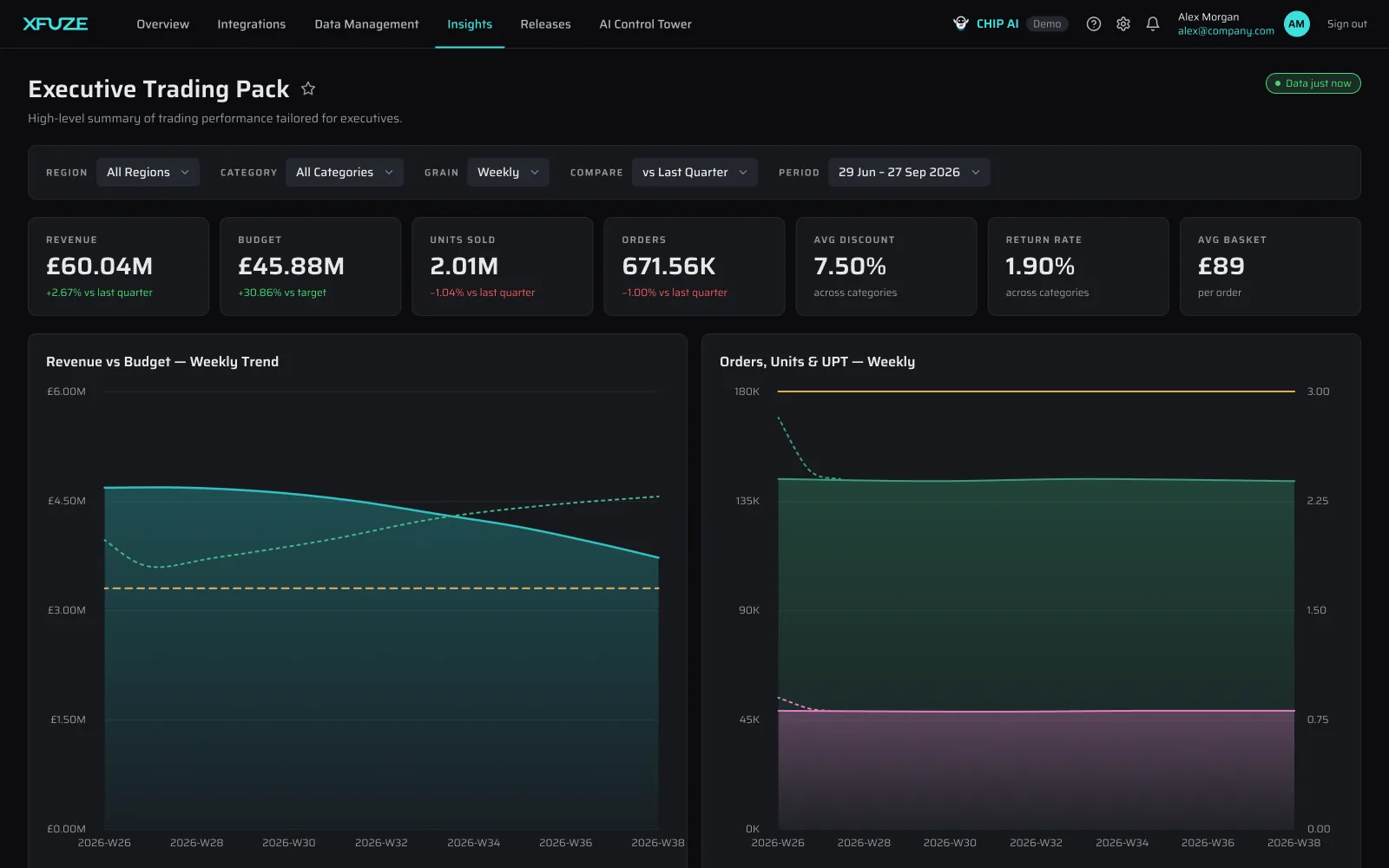
Platforms are beginning to unify these layers into a single operational foundation. For example, Xiatech’s Xfuze platform brings together real-time Integration, Data Management, Orchestration, Analytics and Agentic AI within one composable architecture, enabling retailers to move from isolated pilots to scalable, governed execution.
Agentic AI Shopping is only the beginning. The retailers that invest in the right foundation today will capture disproportionate market share as AI-driven commerce accelerates.







Discover how Xfuze can benefit your business
Book a call and find out why organisations such as Flying Tiger Copenhagen, G-Star RAW, Moss, REISS, Woodland Trust and others rely on Xiatech to accelerate their business transformation and performance.