




How to build an Enterprise Architecture to scale AI
How IT leaders and enterprise architects can build the architecture required to scale AI across the organisation, with practical design principles and tips.



Your business wants AI. The board is asking about it, business leaders are exploring new capabilities and teams are experimenting with tools. The question for IT leaders and enterprise architects is straightforward but challenging: how do you plan and deliver the architecture required to support AI across the organisation?
AI does not scale on top of disconnected systems, data and processes.
Most organisations already operate dozens, sometimes hundreds, of systems across commerce, operations, finance, marketing and supply chain. The challenge for enterprise architects is not starting from scratch, but evolving this landscape so that data, decisions and processes can flow across it.
Deploying a single AI model or experimenting with a chatbot may deliver a quick win, but sustained value requires something more fundamental. Organisations need an enterprise architecture designed to support AI, where systems, data and processes are connected and able to operate in near real time.
For IT leaders and enterprise architects, the goal is not simply introducing AI tools. It is designing a foundation that allows AI to operate reliably across the business, supporting decisions, automation and new customer experiences. A practical approach is to define the long-term architectural vision while delivering change incrementally through meaningful business scenarios.
Building the foundation for AI
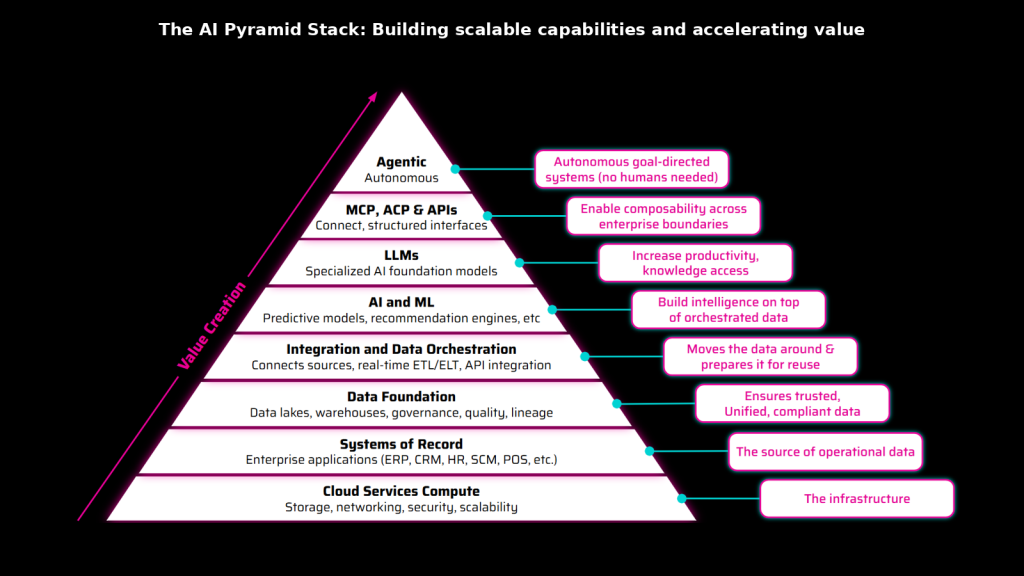
Before launching individual AI initiatives, organisations should consider the target architecture required to support AI across the business.
In retail and CPG environments this often begins with connecting systems that generate operational and customer signals. E-commerce platforms, point-of-sale systems, CRM platforms, marketing technologies, inventory systems and ERP platforms all produce data that can support AI-driven insights.
Modern enterprise architecture therefore needs to prioritise reliable integration so data can flow consistently and in near real time. Increasingly this means capturing event-level data from across systems. Customer purchases, product views, inventory updates, shipments and marketing interactions all generate events. When these signals are connected, organisations gain a far richer understanding of what is happening across the business.
Alongside connectivity, organisations need a trusted data foundation that combines operational and analytical data. A semantic layer defining entities such as customer, product, order and inventory ensures that systems and teams operate from consistent definitions.
In practice, AI-ready architecture combines four core capabilities: integration to connect systems, data management to create trusted information, orchestration to coordinate processes, and analytics with AI to generate insights and decisions.
Platforms such as Xiatech’s Xfuze support this approach by combining these capabilities in a composable architecture, allowing organisations to connect systems, unify data and create a trusted foundation for AI-driven decision making.
Start with a focused domain and scale incrementally
While the architectural vision may span the organisation, the most effective way to deliver it is incrementally.
For many retailers and consumer brands, the customer domain provides a strong starting point because it spans multiple systems and directly influences revenue, loyalty and engagement.
Customer signals are generated across online browsing, ecommerce transactions, in-store purchases, loyalty programmes, marketing interactions and customer service conversations. In many organisations these signals remain fragmented across separate platforms.
By connecting these systems and capturing event-level signals, organisations can establish a unified customer data foundation and a consistent view of behaviour across channels.
Once this foundation exists, analytics and AI can identify high-value customers, detect declining engagement or recommend relevant products and offers. When connected to operational systems, these insights can automatically trigger personalised campaigns, targeted offers or updated recommendations.
This allows organisations to move beyond static reporting towards intelligent, responsive engagement that improves both customer experience and marketing performance.
Practical considerations for enterprise architects
For IT and enterprise architecture teams designing an AI-ready foundation, several principles can help guide development:
- Define the target architecture for AI across integration, data, orchestration and analytics
- Prioritise real-time integration and event-level data flows
- Establish unified data models and consistent definitions for core entities
- Ensure AI insights can trigger operational workflows and automated decisions
- Deliver architecture incrementally through domains such as customer, product or inventory
AI is not simply another technology layer. It changes how organisations make decisions, automate processes and respond to events across the business.
If your organisation is exploring how to design an enterprise architecture capable of supporting AI, we would be happy to help.








Discover how Xfuze can benefit your business
Book a call and find out why organisations such as Flying Tiger Copenhagen, G-Star RAW, Moss, REISS, Woodland Trust and others rely on Xiatech to accelerate their business transformation and performance.