




Why traditional iPaaS blocks agentic AI in retail
Retail AI agents rarely make it past the pilot stage. The problem usually isn't the agent, it's the integration platform underneath it.



Retail leaders have moved on from asking whether AI agents can help their business. The question now is why the agents they have already deployed rarely make it past the pilot stage.
In most cases the problem isn't the agent, it's what sits underneath it. Imagine hiring an excellent merchandiser, then giving them yesterday's stock file, no access to the order system and an instruction to email every decision to someone else to action. However talented they are, they won't move the numbers. That is how many retail AI agents are set up today.
Why retail exposes the limits of traditional iPaaS
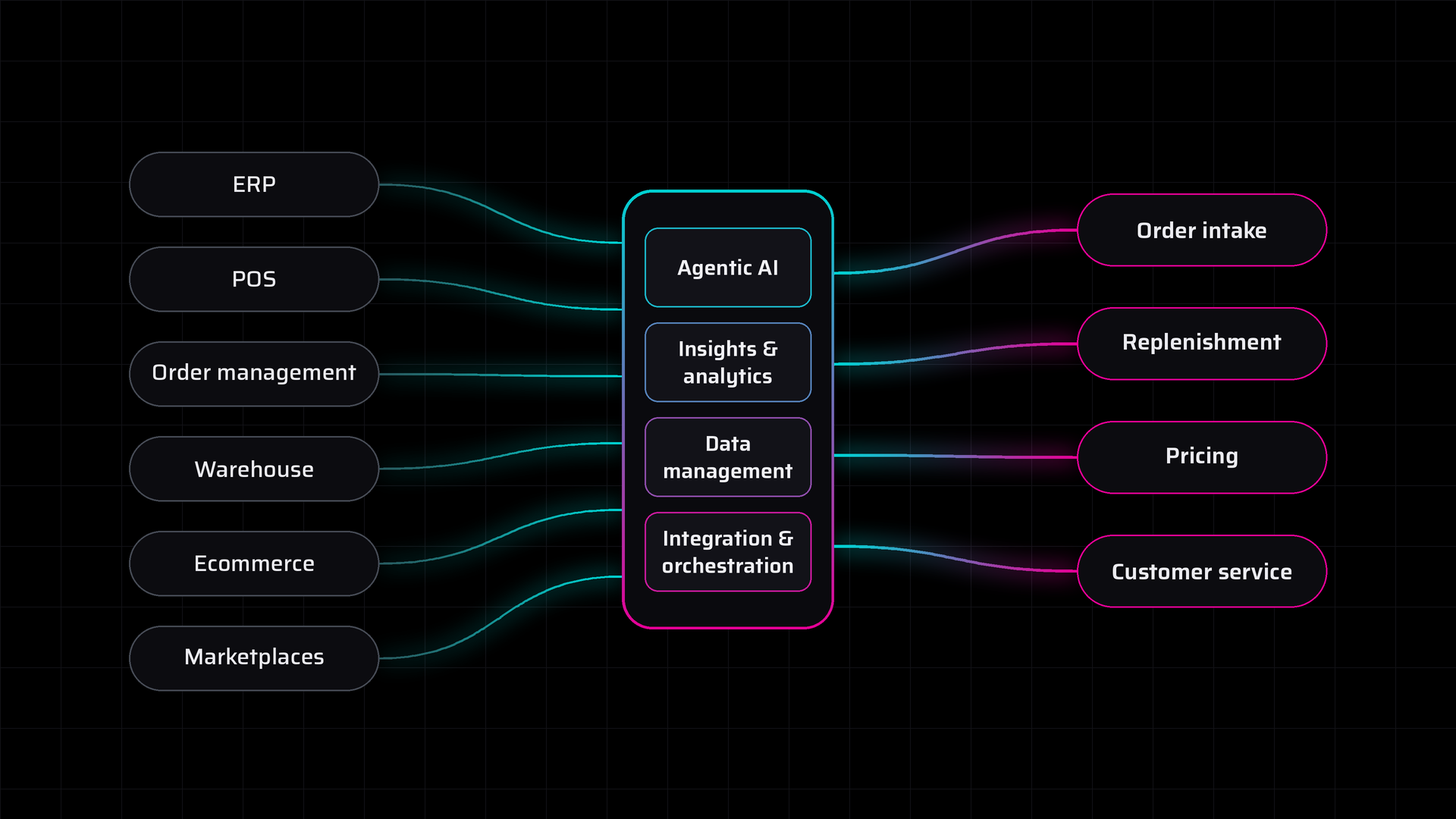
Few industries run on as many systems as retail. ERP, POS, order management, the warehouse, ecommerce, marketplaces, PIM, CRM and loyalty each hold part of the picture, often across several brands and countries.
Traditional iPaaS platforms were built to connect these systems one flow at a time, and they do that job well. Orders, prices and stock levels move reliably from one system to another. The trouble starts when an AI agent needs to see the whole picture and act on it.
Timing is the first issue. Plenty of retail integrations still run in batches, so stock and orders update overnight rather than as they happen, and an agent can't respond to a shortfall in a store if it only finds out the next morning.
Then there is the way the flows are built. Point to point integrations mean every new agent needs its own set of connections, so each use case adds cost and complexity instead of building on the last one.
Connected systems don't automatically mean connected data either. Product, stock and customer records often differ between ERP, ecommerce and the stores, so agents make decisions on a partial view, while the handoffs between merchandising, supply chain and store teams still happen over email and spreadsheets.
The result is agents that can recommend but rarely act, and AI value that stays inside a single team.
What retail AI agents need to work across the business
Getting beyond a single team takes more than a better model. It takes the right foundation beneath it.
That foundation starts with connecting the systems you already have, from ERP and POS to order management, the warehouse, ecommerce and marketplaces, without ripping anything out. It then brings product, stock, order and customer data together into one governed view, so every agent and every team works from the same numbers.
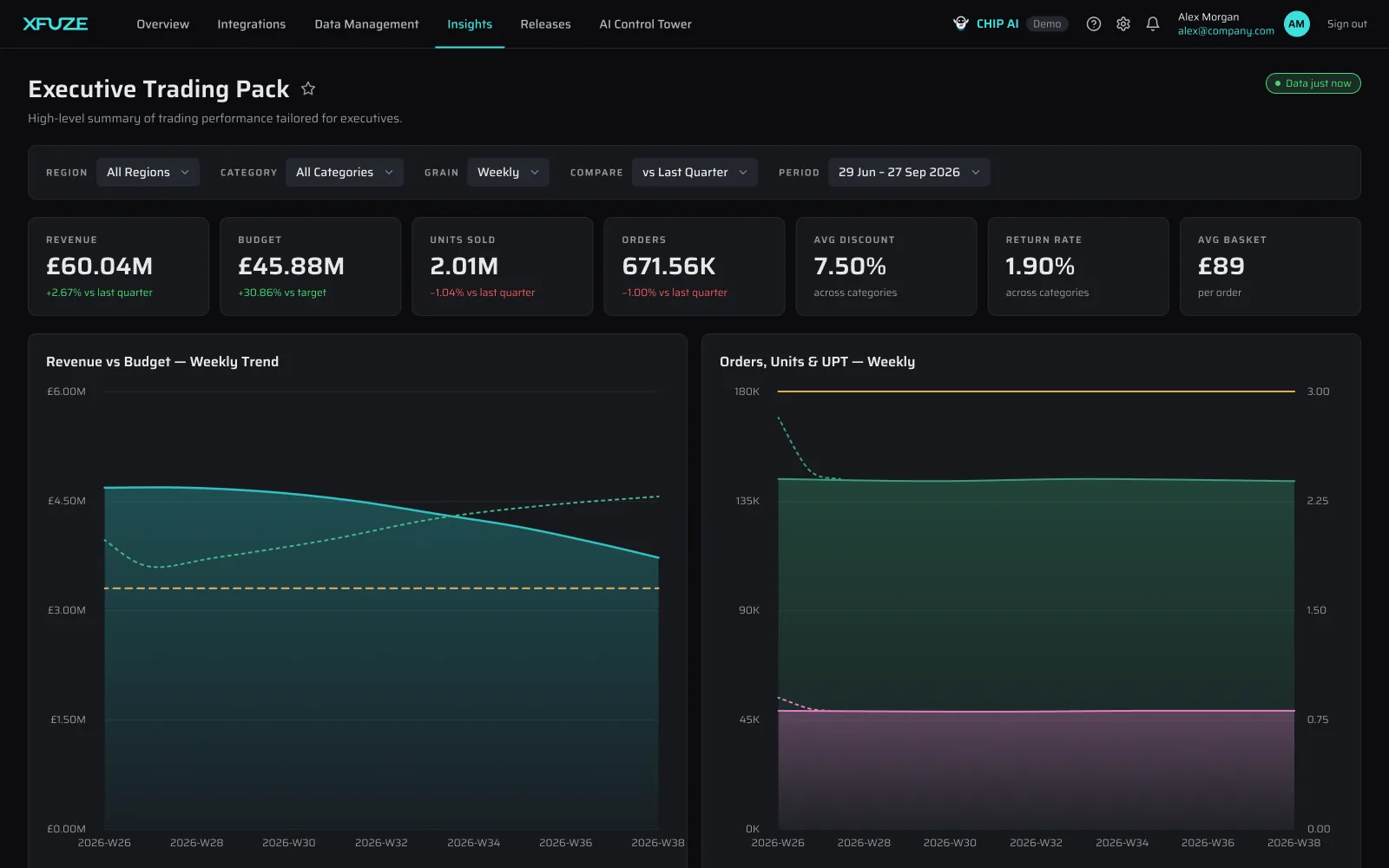
The same foundation also gives every team faster insights, not only the agents. Moss, for example, cut the time to produce and consume insights by 95%.
From there, workflows can run across systems and teams, which means an agent can trigger the next step itself instead of asking someone else to do it. Governance holds it all together: clear rules on what an agent can decide on its own, what needs approval, and a full record of every action, with people in control throughout.
This is what we mean by an agentic ready foundation. With it in place, each new agent builds on what the last one delivered rather than adding another layer of complexity.
Traditional iPaaS vs an agentic ready platform for retail
What it is built for. A traditional iPaaS moves data between systems. An agentic ready platform runs retail processes end to end.
Architecture. Traditional iPaaS relies on point to point flows. An agentic ready platform is event driven and composable.
Stock and orders. Traditional iPaaS often updates in overnight batches. An agentic ready platform works with real time events across stores, online and the warehouse.
Data. Traditional iPaaS copies data between systems. An agentic ready platform creates unified views of product, stock, orders and customers.
The role of agents. On a traditional iPaaS, agents are isolated and advisory. On an agentic ready platform, they work inside live processes.
Adding a new agent. Traditional iPaaS needs new integrations every time. An agentic ready platform reuses the same foundation.
Governance. Traditional iPaaS governs each integration separately. An agentic ready platform governs every agent in one place, with people in control.
A retail example: order intake
Order intake is a good example. Many consumer goods businesses and wholesalers still receive orders as emails and PDFs, each with its own customer part numbers, discontinued codes and mistakes, and their teams spend hours keying them into ERP.
Put an AI agent on a traditional iPaaS and it can read the order, but someone still has to check the codes, fix the errors and post it. On an agentic ready platform, the agent reads the order, matches each customer part number to the right product, flags discontinued codes and posts the clean lines straight to ERP. Only the lines that genuinely need a decision go to a person, which frees the team to spend more time with customers and less on data entry.
That is how the Xfuze Order Intake Agentic Application works. It was developed with Google Cloud and is available on Google Cloud Marketplace, but the agent is only part of the story. What makes it work is the connected ERP, the unified product data and the workflow beneath it.
Questions to ask of your integration platform
If you are planning to scale AI agents, a short conversation with your technology team will tell you a lot.
Ask whether stock, order and sales updates arrive as they happen or in overnight batches, and whether there is one view of product, stock and customers or a different version in every system. Ask what it takes to add a new agent, and whether that means building new integrations every time. Then ask whether an agent can actually trigger the next step in a process, and where the rules for what agents can do are set and recorded.
If the answers point to batches, copies and new builds, your platform will hold your agents back, however good they are.
Frequently asked questions
Why do AI agents stall in retail?
Usually because the platform beneath them was built to move data between systems rather than run retail processes. The agents end up working with delayed, partial data and can't act across ERP, stores, ecommerce and the warehouse.
What is an agentic orchestration platform?
A platform that connects your systems, unifies your data, orchestrates workflows and governs AI agents in one place, so agents can work inside live business processes instead of at the edges.
Do retailers need to replace their iPaaS or ERP to use AI agents?
No. An agentic ready platform connects to the systems you already have and can run alongside your current middleware while you transition.
Which retail processes suit AI agents first?
The best place to start is a process that spans several systems, is manual today and would benefit from faster decisions, such as order intake, stock replenishment, pricing and promotions, or customer service.
How do retailers keep control of AI agents?
By setting clear rules on what each agent can do on its own and what needs approval, and by managing every agent from one AI control tower that records each action.
The foundation decides how far your agents go
The retailers getting real value from AI agents treat the platform as part of the decision, not an afterthought. Xfuze, the Agentic Orchestration Platform, brings integration and orchestration, data management, insights and analytics, and Agentic AI together in one platform. You can start with one agent, govern it in the Xfuze AI Control Tower, and expand across the business from there.
For the wider view across industries, read Why traditional iPaaS platforms block agentic AI from scaling and How to plan, deploy and scale agentic AI.
If you would like to explore where agents could make the biggest difference in your business, talk to our team.






Discover how Xfuze can benefit your business
Book a call and find out why organisations such as Flying Tiger Copenhagen, G-Star RAW, Moss, REISS, Woodland Trust and others rely on Xiatech to accelerate their business transformation and performance.