



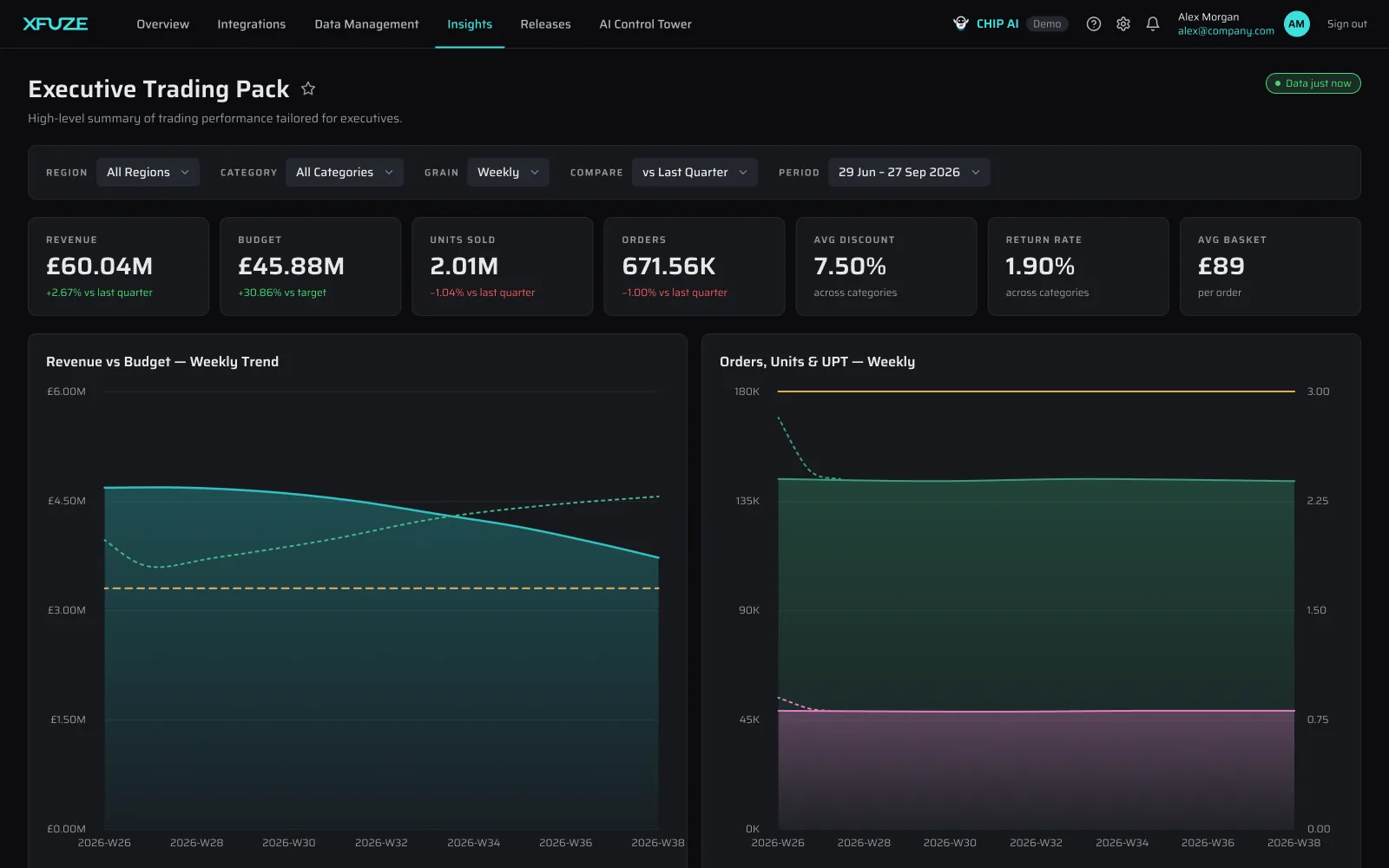

Why you should decouple your architecture today
Organisations that embrace a decoupled architecture have a competitive advantage. They are able to respond rapidly to market opportunities.




Many companies seeking to fully exploit digital technologies and become more data-driven often find that their legacy IT systems are inadequate for the task. The platform-based architecture which underpins the business’s main operations were designed for a different, simpler time.
For example, a Ford Model T is a car. So is a Tesla. Yet, the former, which made car travel widely available and affordable, would fail to meet the most basic needs of anyone driving today. So how do we get to the equivalent of the latter, by which I mean having the IT infrastructure that can deliver our aspiration to become an agile, technology-enabled business?
I’m advocating the best way to do this is by decoupling your architecture. But what do we mean by that?
In the past, a single vendor would have supplied a business with its IT system, which would have been based upon monolithic architecture featuring components, where their user interface (front-end) and the business logic (back-end) that delivers and processes the information are tightly coupled. Fundamentally this makes any changes or applying any updates a complex undertaking, far too slow to meet the needs of businesses operating today.
Plus, as companies become more data-driven, they find that their legacy IT systems, with their monolithic architecture, don’t lend themselves to integrating their data with other systems or analytics software.
Decoupled architecture is a way of separating functionalities. It allows interfacing components within an IT system to function and perform independently of each other. Each component is autonomous until instructed otherwise and any interaction with each other occurs through well-defined protocols. Cloud computing is an example of decoupled architecture.
The benefit for your business is that you can change or update one computing component without needing to change others, allowing for faster development. Decoupled architecture meets increasingly varied and complex integration requirements, such as mobile applications, cloud services and IoT devices and allows data to flow between these more easily while maintaining interconnection with larger core legacy system components.
Decoupled architecture enables businesses to achieve incremental or evolutionary changes and leverage value from these. As I have mentioned in an earlier article, we’re moving away from big IT projects, which can take years before you see any real benefit to your business. Decoupled architecture facilitates easier and faster changes to applications.
Say you are a business that is expanding your e-commerce capability because you want to capitalise on growing online demand for your goods or services. A decoupled architecture would allow you to operate, maintain and evolve your ecommerce platform in a more flexible, modular, scalable way. The back-end e-commerce engine can be integrated with best-of-breed applications depending on requirements, while any front-end changes or adaptations can occur independently.
Decoupled architecture supports businesses that are striving to provide a customer first experience. The good news is that it is possible for any company that is heavily reliant on a largely monolithic legacy IT system to implement solutions that retain core functionality while evolving towards an ecosystem of microservices.







Discover how Xfuze can benefit your business
Book a call and find out why organisations such as Flying Tiger Copenhagen, G-Star RAW, Moss, REISS, Woodland Trust and others rely on Xiatech to accelerate their business transformation and performance.