




What is agentic orchestration?
Agentic orchestration brings your systems, data, insights and AI agents together so you can deploy and scale AI across your business. What it is, how it works and what to look for.




Agentic orchestration is one of the terms you will hear most in 2027 and beyond, as businesses move AI from pilots into everyday work. It is also a term that means different things depending on who you ask.
So we wanted to explain it simply: what agentic orchestration is, how it works, how it differs from the tools you may already have, and what it could mean for your business.
What does agentic orchestration mean?
Agentic orchestration is the coordination of AI agents with the systems, data, workflows and people they work with, so AI can act across a business with governance and people in control.
AI on its own can answer questions and make suggestions. To improve business performance, it needs to work with the rest of your business: the systems your teams use, the data they rely on and the processes that keep things moving. Agentic orchestration connects all of this, so AI can see what is happening, recommend what to do and, with your approval, take the action.
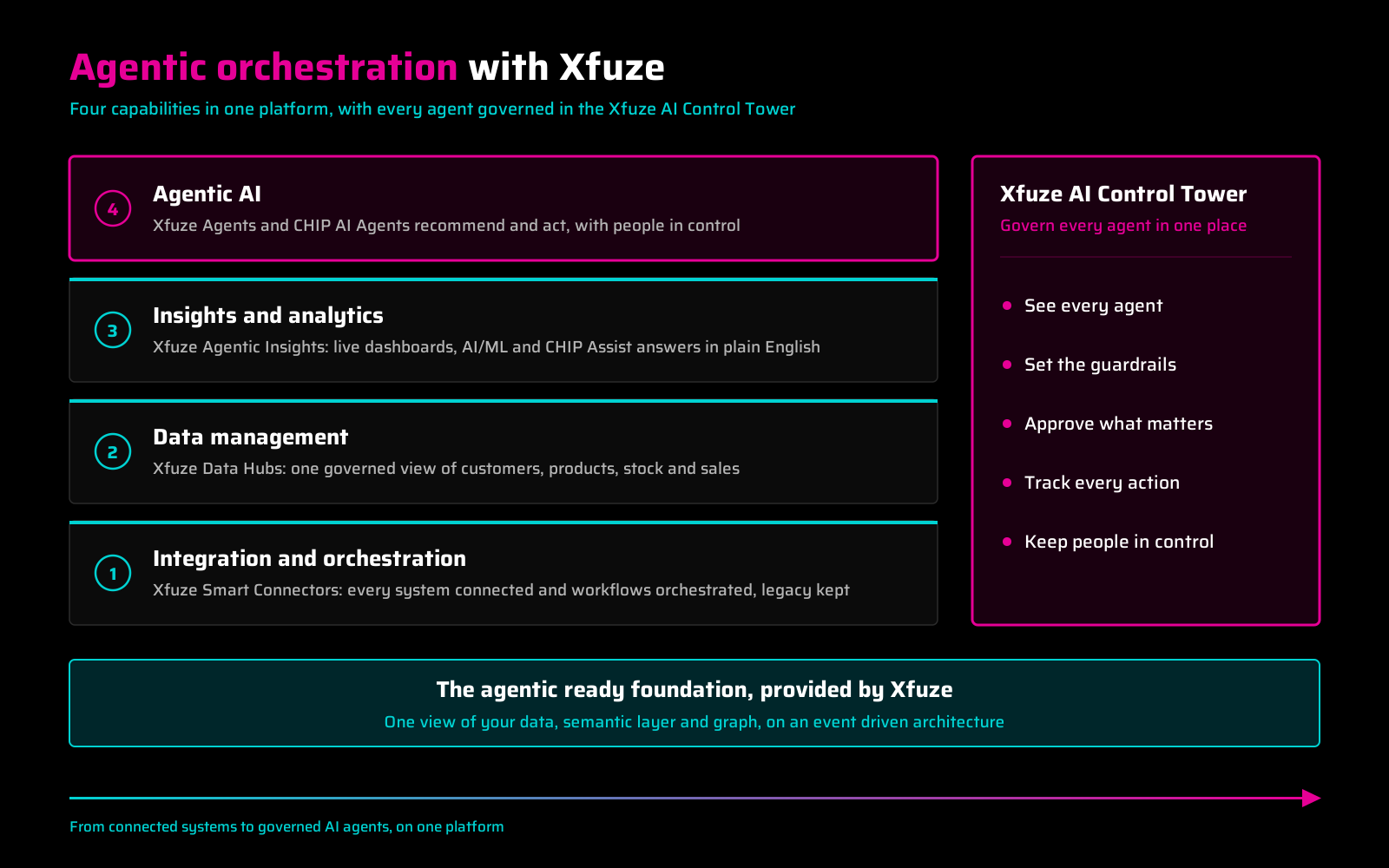
At Xiatech, agentic orchestration rests on four core capabilities in one unified platform:
- Integration and orchestration: connect every system and orchestrate the workflows that move your business, without replacing what you already have
- Data management: unify your data into governed, real time single views of customers, products, stock and sales
- Insights and analytics: give every team live dashboards, AI/ML and answers in plain English
- Agentic AI: deploy agents that recommend and act, governed in one place with people in control
Our view
You will see the term used in different ways. Automation vendors use it for coordinating bots, agents and people inside a single process. AI platform vendors use it for coordinating agents with each other.
We think both are too narrow for a business that wants AI to improve performance. Agents are only as useful as the systems, data and insights they can reach, so agentic orchestration has to cover all of them, in one platform, with people in control. That is why we built Xfuze as an Agentic Orchestration Platform rather than an agent tool.
Why does agentic orchestration matter now?
Businesses need AI to improve performance today. Most have run a pilot, but far fewer have AI working across the business, because agents can only act on what they can see and reach. Gartner predicts that through 2026, organisations will abandon 60% of AI projects that are not supported by AI ready data.
An agentic orchestration platform gives you the agentic ready foundation today: your systems connected, your data unified and your processes orchestrated. You can start with the capability you need most, such as a single view of your data or insights for one department, and add agents when you are ready. What you set up first carries straight into your next step.
How does agentic orchestration work?
The four capabilities work together in one platform. Each builds on the one beneath it, and an AI control tower governs every agent across all of them.
Take stock availability. Integration brings in live sales and stock from your stores, ecommerce and warehouse. Data management turns that into one view of stock by product and location. Insights show your team where you are about to run out and why. An agent then recommends moving stock between locations and, once your team approves, raises the transfer in your warehouse system, with every step recorded in one place.
Underneath, one unified view of your data, a semantic layer and a graph run across all four capabilities on an event driven architecture. The semantic layer means every team, dashboard and agent uses the same definition of every metric. The graph gives agents memory, so they act with the context of what has happened before.
How is agentic orchestration different from iPaaS, BI, RPA and agent builders?
Agentic orchestration overlaps with tools you may already have. Each of them does part of the job.
| What it does | What it leaves out | |
|---|---|---|
| iPaaS and integration tools | Moves data between applications through connectors and APIs | A governed single view of your data, insights and agents that act |
| Data warehouses and data platforms | Stores data for reporting and analysis | Unifying, matching, deduplicating and enriching data into live, governed records that systems and agents can act on |
| BI and analytics tools | Shows what happened in dashboards and reports | Recommendations and action: someone still has to act on what they show |
| RPA and process automation | Automates fixed, rules based tasks | Reasoning, unified data and governance across many agents |
| AI agent builders | Lets teams build individual agents on a language model | Live connections to business systems, shared data and one place to govern agents as they multiply |
Data management is the part most often missed. Moving data between systems is not enough for AI. It has to be unified, cleansed, transformed, matched, deduplicated and enriched into governed single views of your customers, products, stock and sales, and kept live as your source systems change. That is what lets agents make the right decision and means every team works from the same numbers.
When you compare options, ask whether your AI can act in your business systems, on the same governed data, with every action visible and approved where needed. If that takes four separate tools working together, the cost and risk of scaling AI grow with every agent you add.
What should you look for in an agentic orchestration platform?
Use these seven questions when you compare vendors.
- Does it connect your existing systems without replacing them? Look for prebuilt connectors to ERP, ecommerce, POS, warehouse and CRM systems, with real time and batch integration.
- Does it unify your data into one governed view? Your teams and your agents should work from the same cleansed, matched and current data, not copies held in separate tools.
- Does it give every team insights? Live dashboards, AI/ML and answers in plain English help people see what is happening and why, whether or not they use agents yet.
- Can it orchestrate work across systems, agents and people? An agent should be able to trigger a process, hand work to another agent and pause for your approval.
- Is governance built in? You should be able to see every agent, set guardrails, approve what matters and keep a record of every action in one place.
- Can you start where you are? Begin with integration, a single view of your data, insights or one agent, and add the rest without rebuilding.
- Does it support open standards? Look for Model Context Protocol (MCP), so agents can securely use your tools and data, and Agent2Agent (A2A), so agents from different vendors can work together. Open standards protect you from lock in as the market moves.
What does agentic orchestration look like in retail?
Retailers run on connected decisions across stores, ecommerce, stock and customers, which makes them a natural fit. Typical starting points include:
- Stock replenishment: spot fast selling products and low stock, recommend the order and raise it once approved (Xfuze Stock Replenishment Agent)
- Pricing and markdown: adjust prices within approved rules in response to live demand, stock and margin (Xfuze Dynamic Pricing & Markdown Agent)
- Order intake: read orders in any format, fix part numbers and post clean orders to the ERP (Xfuze Order Intake Agentic Application)
- Customer service: answer “where is my order” and resolve returns within policy (Xfuze WISMO Agent)
The same approach applies in consumer goods, wholesale, travel and hospitality.
Xfuze: the agentic ready platform
Xfuze, the Agentic Orchestration Platform, gives organisations the foundation to deploy AI across the business. It brings integration and orchestration, data management, insights and analytics, and Agentic AI together in one cloud native platform, so you have the agentic ready platform today.
Moss cut the time it takes to produce and consume insights by 95% with Xfuze.
With Xfuze you can:
- Turbocharge your legacy: connect the systems you already run with Xfuze Smart Connectors and extend the value of those investments
- Unlock your data: create governed single views of customers, products, stock and sales with Xfuze Data Hubs
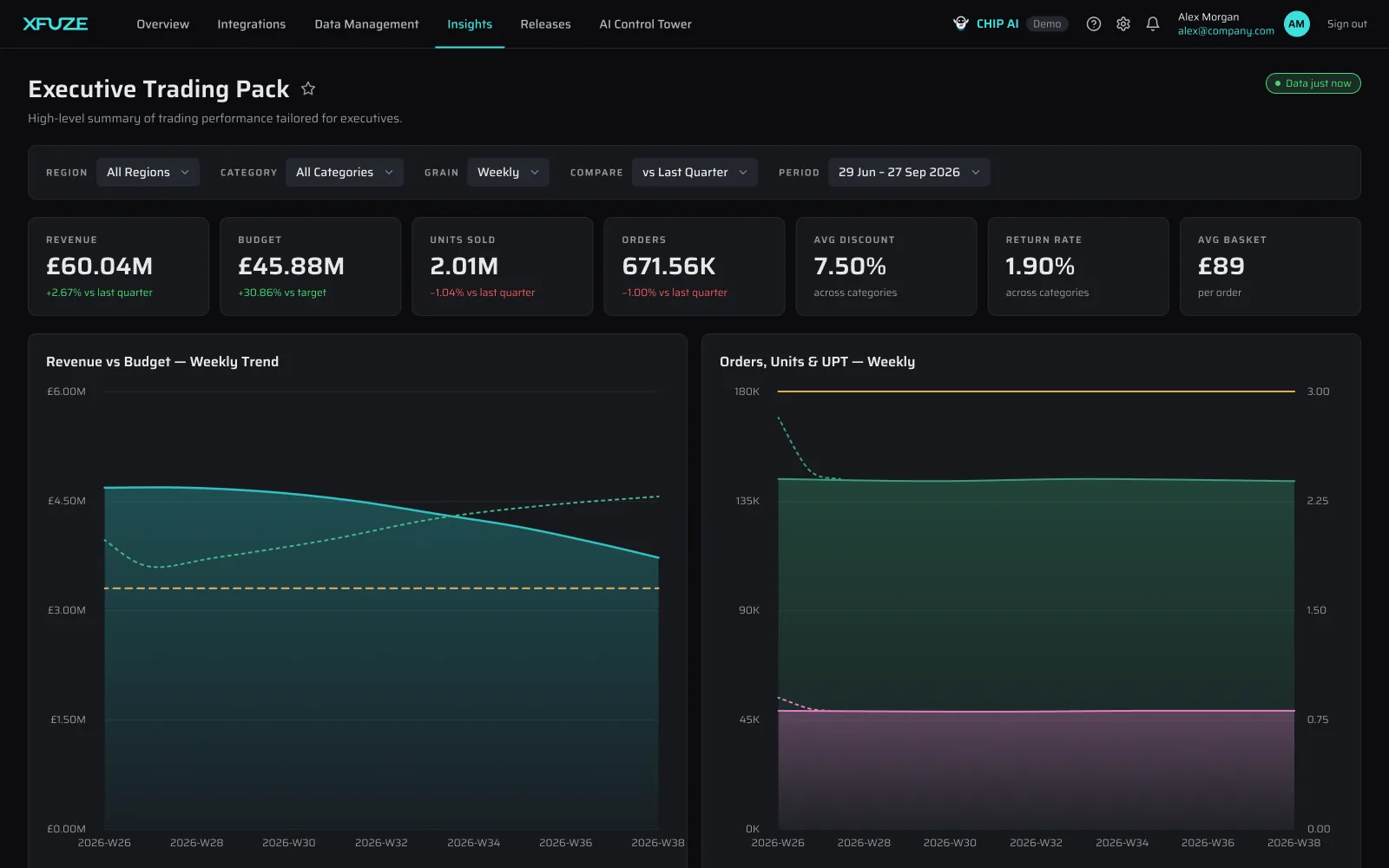
- Accelerate digital transformation: give every department prebuilt dashboards with embedded AI/ML through Xfuze Agentic Insights, with CHIP, your AI assistant, answering your questions and recommending what to do next
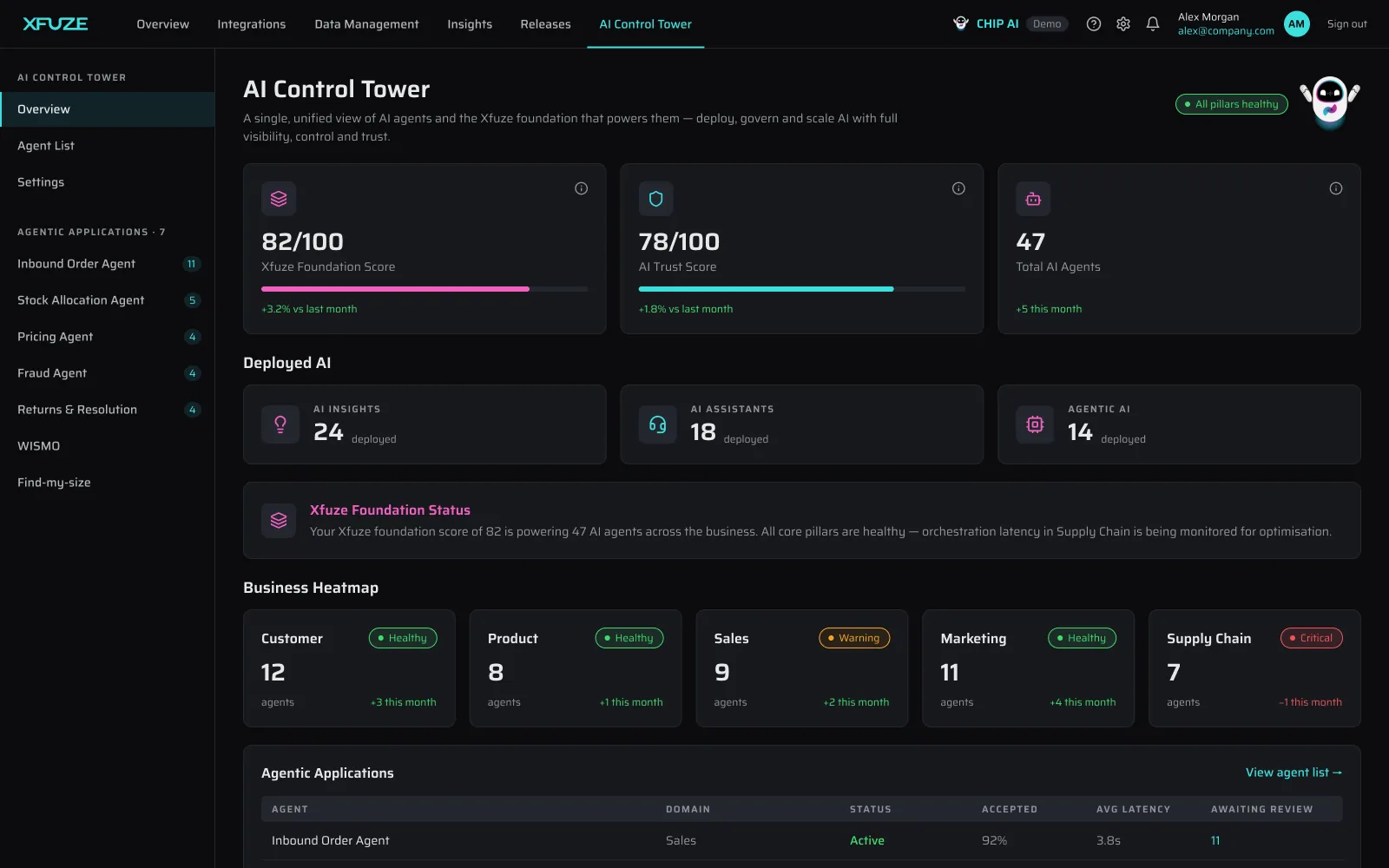
- Enable AI: deploy Xfuze Agents, AI agents that work for you across stock, pricing, orders, service and finance, and manage, govern and run them in the Xfuze AI Control Tower
Xfuze Agents and the Xfuze AI Control Tower
Xfuze Agents are line of business AI agents that work for you, each built for a specific business use case such as stock replenishment, pricing, order intake or customer service. They recommend or act on live, governed data, with people in control. You start with one agent, the Xfuze AI Control Tower comes with it, and you add more as you see the value.
The Xfuze AI Control Tower is one place to manage, govern and run your AI agents. You can see every agent and what it is doing, set the guardrails, approve what matters and track every action, so scaling from one agent to many does not mean losing control.
CHIP AI Agents are native to Xfuze and work across the whole platform. CHIP Assist, your AI assistant, answers your questions, recommends what to do next and builds integrations, workflows, pipelines and analytics in minutes. CHIP Pulse alerts you when something important changes and tells you why. CHIP Dashboard Builder creates dashboards from a plain English description, and CHIP Explore shows where AI will pay back first.
Underneath sits the Xfuze Agentic Enablement Layer, which provides security, model access, orchestration and tooling, with full support for Model Context Protocol (MCP), Agent2Agent (A2A) and Agent to UI (A2UI).
You can start with any capability and add the others when you need them, and nothing you set up is thrown away as you grow. Xiatech won AI Innovation of the Year at the UK IT Industry Awards 2026.
What does it mean for business and technology leaders?
For business leaders
Agentic orchestration is a way to improve business performance, not a technology project for its own sake. Most businesses get there in three steps:
- See: a single view of your data, with insights for each department
- Ask: CHIP Assist answers questions in plain English and recommends what to do next
- Act: switch on agents where you trust them, with the Xfuze AI Control Tower keeping people in control
Agents take on the routine work, so your people spend more of their time on the decisions that grow the business.
For technology leaders
- Architecture: cloud native, cloud agnostic and MACH certified, on an event driven architecture with a semantic layer and graph across the platform
- Open standards: full support for Model Context Protocol (MCP), Agent2Agent (A2A) and Agent to UI (A2UI), through the Xfuze Agentic Enablement Layer
- Your existing stack: connects to ERP, ecommerce, POS and warehouse systems, and works with data platforms such as Snowflake, BigQuery, Databricks and Azure Synapse rather than replacing them
- Security and governance: guardrails, access control, human approval and a full audit trail for every agent in the Xfuze AI Control Tower
- Monitoring: end to end visibility of integrations, data, workflows and agents, so issues are caught before your teams or customers notice
Frequently asked questions
What is an agentic orchestration platform?
A platform that brings integration and orchestration, data management, insights and analytics, and Agentic AI together, so you can deploy and scale AI across your business with people in control.
How is agentic orchestration different from AI agent orchestration?
AI agent orchestration usually means coordinating agents with each other. Agentic orchestration also connects the systems, data, workflows and insights those agents depend on.
Do I need to replace my existing systems?
No. An agentic orchestration platform connects to the systems you already run, such as ERP, ecommerce, POS and warehouse management, and extends the value of those investments.
How do you keep AI agents under control?
In one place, such as the Xfuze AI Control Tower, where you can see every agent, set guardrails, approve key decisions and keep a record of every action.
Where should a business start?
Where the value is clearest. That might be connecting systems, a single view of your data, insights for one department or one agent for a use case such as stock replenishment. On the right platform, each step builds on the last.
What are CHIP AI Agents?
CHIP AI Agents are the family of AI agents native to Xfuze. They include CHIP Assist, your AI assistant, which answers questions, recommends next steps and builds integrations, workflows and analytics in minutes, plus CHIP Pulse for proactive alerts, CHIP Dashboard Builder and CHIP Explore.
What is a semantic layer, and why do agents need one?
A semantic layer gives every metric one agreed definition. When dashboards, teams and agents all work from the same definitions, the recommendations and actions agents take are consistent with how your business measures performance.
Which vendors offer agentic orchestration for retail?
Xiatech offers Xfuze, the Agentic Orchestration Platform, used by retailers and brands including Flying Tiger Copenhagen, G-Star RAW, Moss and WHSmith.




Discover how Xfuze can benefit your business
Book a call and find out why organisations such as Flying Tiger Copenhagen, G-Star RAW, Moss, REISS, Woodland Trust and others rely on Xiatech to accelerate their business transformation and performance.