




What is AI agent governance? 10 questions to answer about every agent
AI agent governance means knowing who owns each agent, what it can do, what it did and whether it delivers. The 10 questions every business should be able to answer.




AI governance is one of the most talked about topics in business right now, and for good reason. AI agents are no longer something your teams are just testing. They are raising orders, changing prices and answering customers, and you need to know they are doing the right thing.
But ask five people what AI governance means and you will get five different answers. So we wanted to make it practical: what AI agent governance is, the questions you should be able to answer about every agent, and how to put it in place without slowing your teams down.
What is AI agent governance?
AI agent governance is how a business stays in control of its AI agents: knowing who owns each one, what it can access and decide, what it did, and whether it is delivering the outcome it was deployed for.
Agents are different from earlier AI because they act. They update records, raise orders, change prices and reply to customers. Governance makes sure every action is visible, within limits the business has agreed and approved where it matters, with people in control.
Why does AI agent governance matter now?
The number of agents in a business only goes up. Gartner expects 33% of enterprise software applications to include agentic AI by 2028, up from less than 1% in 2024. Agents are arriving inside the tools you already buy, built by your own teams and deployed by partners, often without one place to see them all.
In 2025, Gartner predicted that over 40% of agentic AI projects will be cancelled by the end of 2027, due to escalating costs, unclear business value or inadequate risk controls (Gartner). Good governance helps with all three.
Our view
Most AI governance today starts with IT and security: who an agent is and what it can access. That matters, but it does not cover what the agent does inside your business processes.
Agents that act on orders, stock, pricing and service need governing inside the process too: what they are allowed to decide, which data they act on, how they work with other agents and people, and whether they deliver the result they were deployed for. We call this operational governance.
Agents also increasingly work across platforms, for example running in one system while changing records in your ERP. So governance needs to sit where the action happens, and leaders should decide where that is before agents scale, not after.
The 10 questions to answer about every AI agent
You should be able to answer these for any agent in your business within a minute. If an answer takes longer to find, that agent is a risk. The first five are about control and security. The last five are about how the agent performs in your business, and that is where we see the biggest gaps.
Control and security
1. Who owns it?
A named person in the business, not only the person who built it, so the agent keeps running properly when people change roles.
2. What can it access?
Which systems and data it can reach, and whether it can only read or can also act. Start with read and widen access as trust grows.
3. What did it do?
Every action recorded in one place, so you can see what the agent did, when and why.
4. Which record is the one you trust?
Agents often act on data held in one system, such as your ERP, while running in another. Agree which system owns each record and which log is the official account of what happened.
5. How do you pause or stop it?
A clear way to pause or switch off any agent quickly, tested before you need it.
Business performance
6. What can it decide on its own?
Which decisions it makes alone, which need approval and who approves them. A replenishment agent might raise small stock transfers automatically, while larger ones go to a merchandiser.
7. Is it acting on current, governed data?
An agent is only as good as the data it sees. Stock, orders, product and customer data should be unified, cleansed and live, so the agent and your teams work from the same numbers.
8. Which process is it part of?
Where it sits in the end to end process, which systems it acts in, which agents it hands work to and when a person steps in. Agents that each look fine on their own can still undo each other's decisions.
9. Is it delivering the outcome it was deployed for?
Each agent measured against the business result it was built for, such as on shelf availability, margin or time saved, not just whether it ran.
10. Is it ready to be trusted with more?
Evidence from its track record to move it from recommending, to acting with approval, to acting on its own within agreed limits.
How do you build trust in AI agents step by step?
Good governance is what lets you give agents more to do. Most businesses move each agent through three stages:
- Recommend: the agent suggests what to do and your people decide.
- Act with approval: the agent prepares the action and a person approves it before it happens.
- Act within limits: the agent acts on its own within guardrails you set, and anything outside them comes to a person.
An agent moves to the next stage when its record answers questions 9 and 10: it is delivering the outcome, and its decisions have held up.
Take the Xfuze Order Intake Agentic Application. It reads incoming orders, matches customer part numbers and posts clean lines to your ERP, while only the lines that need a decision go to a person. As its record builds, more of the work can run on its own, with people still in control.
Why does governance start with the foundation?
You cannot govern an agent that runs on data you cannot trust or systems it cannot reliably reach. When your systems are connected, your data is unified and your processes are orchestrated, the answers to questions 2, 3, 7 and 8 are built in rather than pieced together for every agent.
That is why governance and agentic orchestration go together: the foundation that lets agents act across your business is also what lets you see and control what they do.
How does the Xfuze AI Control Tower help?
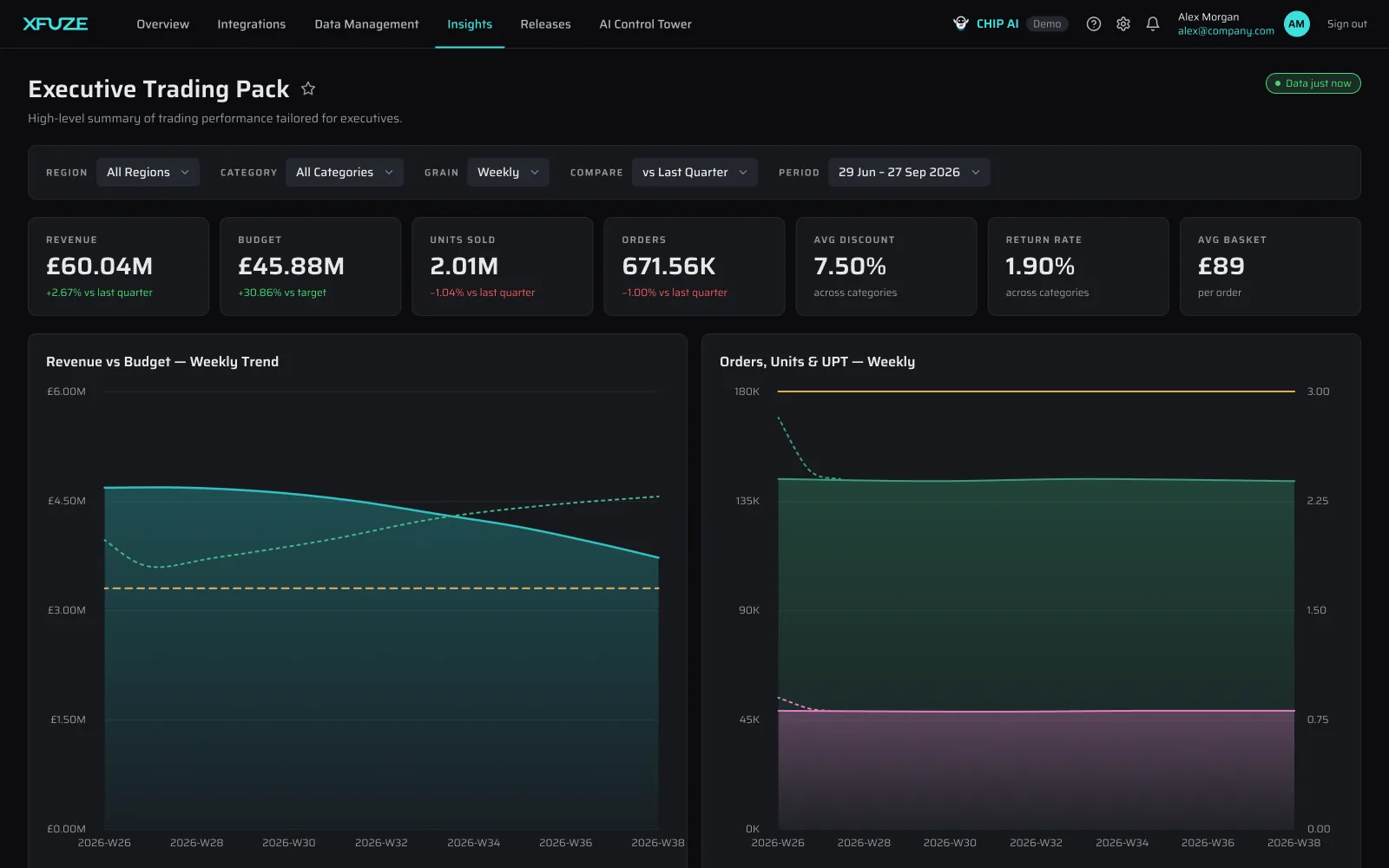
The Xfuze AI Control Tower is one place to deploy, manage and govern your AI agents, with your people in control of what every agent does. It comes with your first Xfuze Agent, so governance is in place from day one, and it runs on Xfuze, the Agentic Orchestration Platform, which provides the foundation underneath.
| Question | How Xfuze helps |
|---|---|
| 1. Who owns it? | The Control Tower shows every agent and who owns it |
| 2. What can it access? | You set what each agent is allowed to do, with guardrails |
| 3. What did it do? | Every action is tracked and recorded in one place |
| 4. Which record is the one you trust? | Xfuze Data Hubs hold the governed record, and every agent action is recorded in one place |
| 5. How do you pause or stop it? | You can pause an agent and see what is live and what is paused |
| 6. What can it decide on its own? | You decide what each agent does alone and what needs human approval |
| 7. Is it acting on current, governed data? | Xfuze Data Hubs give agents unified, governed and live data |
| 8. Which process is it part of? | Xfuze orchestrates workflows across systems, agents and people |
Underneath sits the Xfuze Agentic Enablement Layer, which provides security, model access, orchestration and tooling, with full support for Model Context Protocol (MCP), Agent2Agent (A2A) and Agent to UI (A2UI). CHIP AI Agents, native to Xfuze, run on the same governed foundation.
Frequently asked questions
What is AI agent governance?
How a business stays in control of its AI agents: who owns each one, what it can access and decide, what it did, and whether it delivers the outcome it was deployed for.
How is AI agent governance different from AI governance?
AI governance covers all AI in a business, including policies, ethics and models. AI agent governance focuses on agents that take action in your systems, where control, approval and a record of every action matter most.
What is an AI control tower?
One place to see, manage and govern every AI agent, set what each one can do, approve key decisions and track every action. The Xfuze AI Control Tower does this for Xfuze Agents, with people in control.
Who should own AI agent governance?
It is shared. Each agent needs a named owner in the business, IT and security set access and standards, and leadership needs one view across all agents.
Does governance slow AI down?
No. Clear limits and approvals are what let you give agents more to do with confidence. Without them, teams fall back on manual checks that stop agents delivering value.
Where should a business start?
With one agent on a use case that matters. Answer the 10 questions for it, put it in a control tower from day one and expand from there. Our guide to launching and scaling AI agents covers the steps.




Discover how Xfuze can benefit your business
Book a call and find out why organisations such as Flying Tiger Copenhagen, G-Star RAW, Moss, REISS, Woodland Trust and others rely on Xiatech to accelerate their business transformation and performance.